Arbat
Zaułki pełne historii
Stary Arbat z teatrami i muzeami-mieszkaniami, ciche zaułki i kontrastowy Nowy Arbat.
O dzielnicy
Arbat appears in chronicles from the late 15th century. The origin of the name is disputed; one popular theory links it to the Arabic word “rabad”, meaning suburb.
After the fire of 1812 the area became a favourite of the nobility and intelligentsia. Writers, scholars and musicians settled here, while lane names such as Denezhny, Starokonyushenny and Serebryany preserve the memory of earlier craft settlements.
In the 1960s Kalininsky Prospekt — today’s New Arbat with its “open book” towers — was cut through the old blocks. In 1986 Old Arbat became Moscow’s first pedestrian street.
- Okręg
- Centralny okręg administracyjny
- Status
- Dzielnica
- Ludność
- 36 942 (stan na 2025)
- Powierzchnia
- 2,1 km²
- Stacje w granicach dzielnicy
- 6
Ludność według Wikidata na podaną datę; powierzchnia obliczona z granicy OpenStreetMap; stacje według położenia wewnątrz granicy.
Co zobaczyć
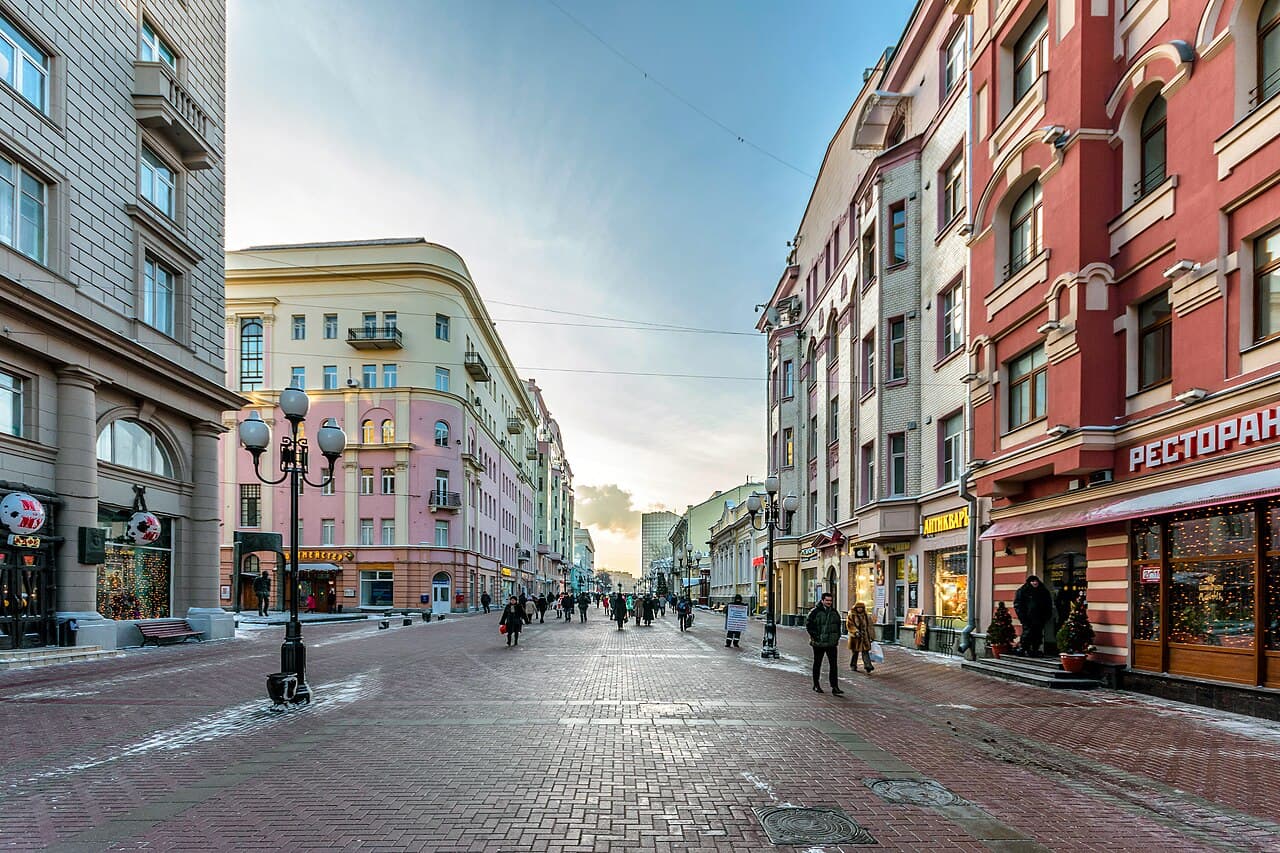
Old Arbat
A pedestrian street about a kilometre long with theatres, museums and street musicians.
Pushkin Memorial Apartment
The house at Arbat 53 where the poet settled in 1831 after marrying Natalia Goncharova.
Vakhtangov Theatre
One of Moscow’s leading drama theatres, standing right on Old Arbat.
Melnikov House
Architect Konstantin Melnikov’s home and studio (1927–1929), made of two interlocking cylinders.
Foreign Ministry building
One of the Seven Sisters, the Stalin-era high-rises, on Smolenskaya-Sennaya Square, built in 1948–1953.
Gdzie na spacer
- 01
Old Arbat and its lanes
Walk the whole street, then return in parallel via Sivtsev Vrazhek and Starokonyushenny Lane.
- 02
Spasopeskovsky Lane
A quiet square by the Church of the Saviour on the Sands, familiar from Vasily Polenov’s painting “A Moscow Courtyard”.
- 03
The boulevards
Gogolevsky and Nikitsky Boulevards form the district’s green edge and part of the Boulevard Ring.
Architektura
Step sideways here: turn off the main street and the souvenir stalls give way to Empire-style mansions, Art Nouveau apartment houses and lamplit courtyards.Melnikov House
Hexagonal honeycomb windows and a private house, rare for Soviet Moscow — an avant-garde icon.
New Arbat
The rhythm of tall “book” towers and glass pavilions — an ensemble of Soviet modernism.
Foreign Ministry tower
A stepped silhouette and spire — the image of post-war Moscow.
Art Nouveau apartment houses
Oriel windows, majolica inserts and sculpted décor on Arbat and the neighbouring lanes.
Transport
Arbatskaya and Smolenskaya stations exist on two lines each — Arbatsko-Pokrovskaya and Filyovskaya. Kropotkinskaya and Biblioteka imeni Lenina are close by; the district itself is best explored on foot.
Na schemacie transportuStacje w granicach dzielnicy
Ciekawostki
- 01
Old Arbat became Moscow’s first pedestrian street in 1986.
- 02
Vasily Polenov’s “A Moscow Courtyard” (1878) was painted in Spasopeskovsky Lane.
- 03
In 2002 a monument to Bulat Okudzhava, author of songs about Arbat, was unveiled at the corner of Arbat and Plotnikov Lane.
Galeria zdjęć
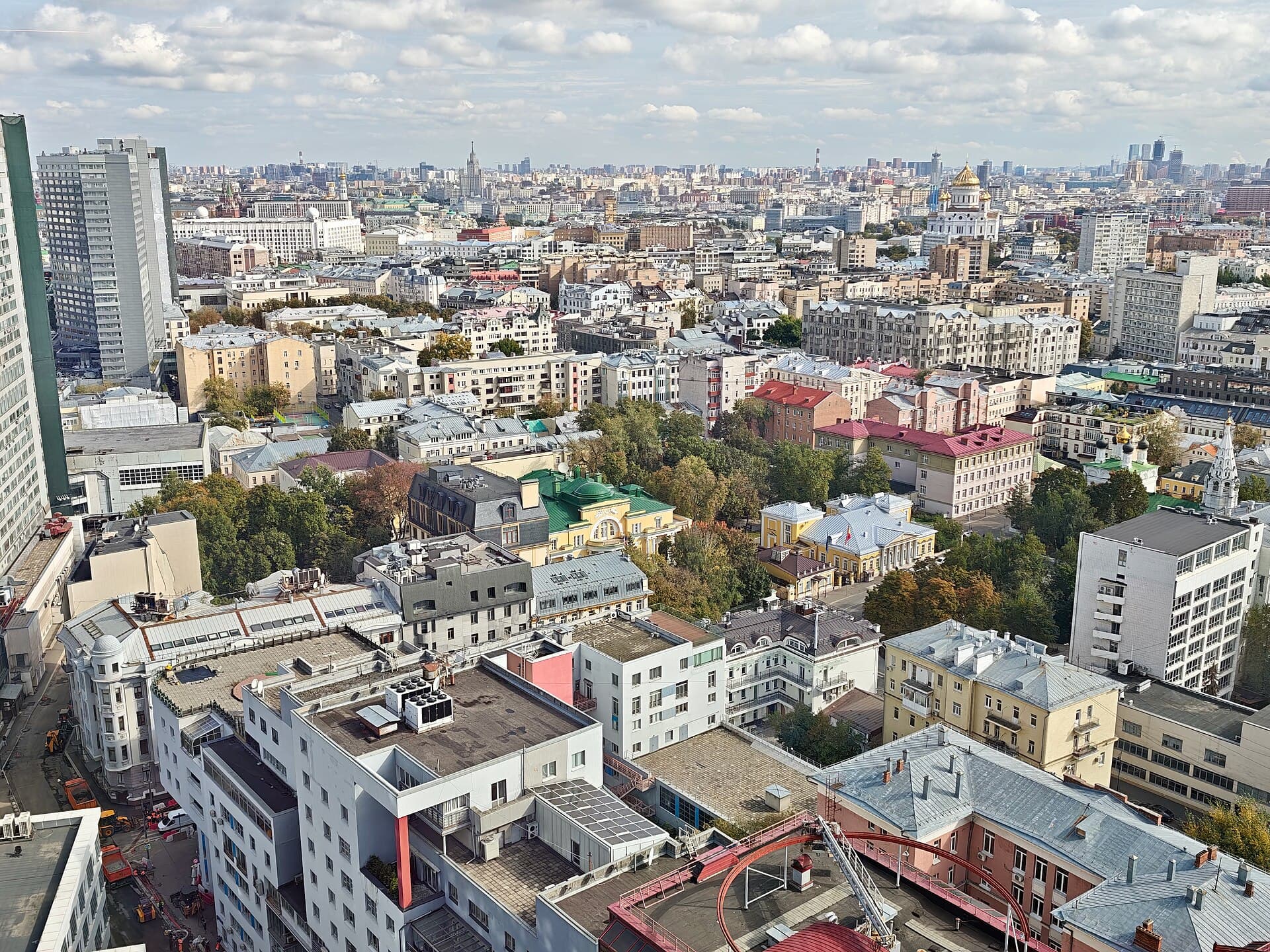
Arbat, Moscow: photograph from Wikimedia Commons
Na mapie
Granice: © współtwórcy OpenStreetMap, ODbL. Granica według OpenStreetMap, listopad 2026.